When Everything Is Possible, Nothing Gets Built: Surviving the Greenfield Trap
There's a moment every developer knows. You've just been handed a greenfield project. No legacy spaghetti to untangle, no decade-old comments written by someone who left the company in 2011, no mysterious database columns named flag2. Just a clean repo, an empty folder, and infinite possibility.
And then you just... sit there.
For all the grief we give legacy codebases, they come with a hidden gift: constraints. When you inherit a mess, the problems are already defined. The architecture exists, even if it's painful. The decisions have been made, even if they were bad ones. Your job is to improve, not invent.
Greenfield projects flip that completely. And a lot of developers — even senior ones — underestimate how disorienting that freedom can actually be.
The Paradox of the Empty Repo
Psychologists call it the paradox of choice: when options multiply, decision-making gets harder, not easier. Barry Schwartz wrote a whole book about it. And while he was mostly talking about buying jam at Whole Foods, the same cognitive friction absolutely applies to software architecture.
When you're starting from zero, every choice feels permanent. Pick the wrong framework and you're locked in. Design the wrong data model and you'll pay for it in six months. Choose a folder structure that doesn't scale and future-you will be annoyed every single day.
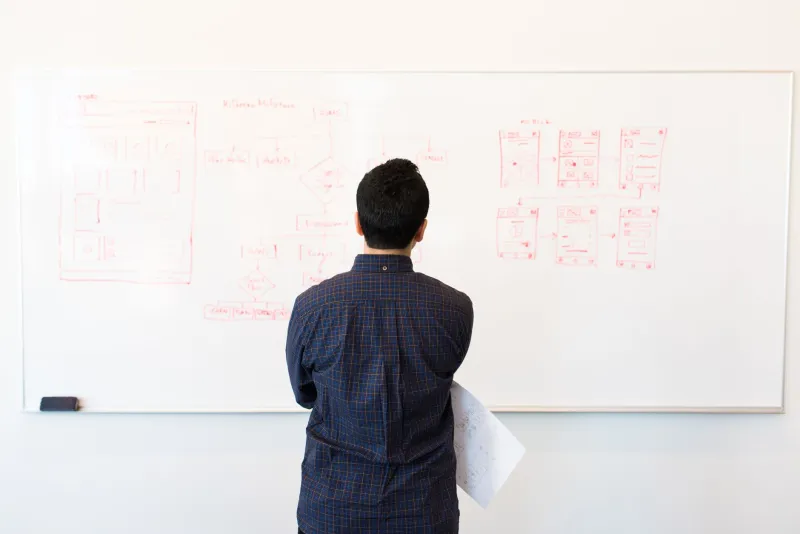
So what do most developers do? They research. Then they research more. They read three competing blog posts about monorepos versus polyrepos. They open twelve browser tabs about whether to go REST or GraphQL. They sketch system diagrams on napkins and whiteboards. They over-architect before a single line of production code exists.
Weeks pass. The canvas stays blank.
Why Greenfield Projects Tempt You to Over-Engineer
Here's the thing about inheriting a legacy system: you can see what went wrong. The shortcuts taken in year one are right there in the codebase, causing pain in year five. That visibility creates strong motivation to do better.
On a greenfield project, you don't have that painful feedback yet — so your brain fills the void with anxiety. What if I make those same mistakes? What if I design myself into a corner? The desire to build something perfect from the start is completely understandable. It's also one of the most reliable ways to never actually ship anything.
Over-engineering a greenfield project is often just fear wearing the costume of professionalism.
Practical Frameworks for Getting Unstuck
Start with the problem, not the solution
Before you pick a stack, write a two-paragraph description of the core problem you're solving. Not the features. Not the technical requirements. The problem. Who has it? What does their life look like when it's solved? This forces you to anchor your early decisions in reality rather than in abstract technical preference.
If you can't describe the problem clearly in plain English, you're not ready to make architecture decisions yet.
Timebox your discovery phase
Research is necessary. Endless research is procrastination with better PR. Give yourself a hard deadline — three days, one week, whatever fits the project scale — to explore options and make foundational decisions. When the timer runs out, you commit and move forward.
Decisions made with 80% of the information are usually just as good as decisions made with 100%, and they happen four times faster. The remaining 20% you'll learn by actually building.
Choose boring technology first
This one comes from Dan McKinley's well-known engineering philosophy, and it holds up. On a greenfield project, the temptation to use the newest, shiniest tools is at its absolute peak. Nobody's stopping you. There's no legacy constraint forcing you onto an older stack.
But novelty has a cost. New tools mean thinner documentation, smaller communities, fewer Stack Overflow answers at 11pm when something breaks. Unless your project requires cutting-edge capabilities, default to the battle-tested option. Save your innovation budget for the parts of the system that actually differentiate your product.
Make your first decision reversible
Not every early choice has to be permanent. When you're stuck between two reasonable options, ask yourself: which one is easier to change later? Pick that one and move on. The goal in the early stages isn't to make perfect decisions — it's to make enough decisions to start generating real feedback from real code.
Abstraction can help here, but use it intentionally. A thin interface between your app and your database means you can swap storage layers later. That's valuable. An elaborate plugin architecture for a feature that doesn't exist yet is just overhead.
The Minimum Viable Architecture
Think of your initial architecture the way a startup thinks about an MVP. It doesn't need to handle every edge case. It doesn't need to scale to ten million users on day one. It needs to be good enough to validate your core assumptions and survive the first real users.
That means:
- One way to do each thing, not three options to accommodate future flexibility
- Flat structures over deep hierarchies until complexity actually demands otherwise
- Explicit over clever — code that future teammates can read without a decoder ring
- Deferred decisions where possible — don't pick a caching strategy before you know what's slow
The architecture you start with is not the architecture you'll end with. That's fine. In fact, that's the plan. Your job is to build something that can evolve, not something that anticipates every evolution.
Reframe What "Starting Fresh" Actually Means
Here's a mindset shift that helps: a greenfield project isn't a blank canvas you have to fill perfectly. It's more like the first cut on a piece of wood. You're not committing to the final shape — you're just beginning to reveal it.
That's kind of the whole ethos of this craft, right? You carve iteratively. You make a cut, assess, adjust. You don't try to finish the sculpture before the chisel touches the material.
Legacy code is hard because you're working around decisions you didn't make. Greenfield projects are hard because you have to make decisions before you have enough information. Both are real challenges. Both are solvable with intentional practice.
The developers who thrive on new projects aren't the ones who make perfect architectural choices upfront. They're the ones who make good enough choices quickly, stay curious as the codebase grows, and aren't afraid to refactor when reality teaches them something their planning couldn't.
Start small. Ship early. Iterate honestly. The blank canvas doesn't have to be terrifying — it just takes practice to see it as an invitation instead of a trap.